What is a hotel SOP? Definition, structure and examples
JVJason Vidalenc··7 min read
The term circulates in training plans and audits, rarely in service corridors. Yet an SOP is neither a quality document nor a staff rulebook: it is the description of how a task must be carried out, whoever carries it out.
In shortIn short: what is a hotel SOP?
An SOP (Standard Operating Procedure) describes how an operational task must be carried out: its trigger, its owner, its steps in order, the expected result and the way to control it. In hotels, the most common SOPs cover check-in, the room turn-down, the shift handover, the handling of a technical incident and the management of a complaint.
Definition: what an SOP is, and what it is not
An SOP is a written operating method. It answers a very concrete question: if the person who usually does this task is not here this morning, can someone else run it correctly by reading one page?
It is not a staff rulebook, which states obligations. It is not a job description, which draws a perimeter. It is not a service charter, which expresses an intention. An SOP describes gestures, in order, with a result that can be verified.
A procedure that a first-time reader cannot execute is not an SOP — it is a memory aid for the person who wrote it.
What a hotel SOP contains
Seven sections are enough. Beyond that, the procedure becomes a compliance document nobody re-reads, and it stops serving on the floor.
Section
What goes in it
Object
The task in one line, in the teams' own vocabulary. “Turn down a room after a check-out”, not “room reinstatement process”.
Trigger
What starts the task: a recorded departure, a call from the front desk, a fixed time of day.
Owner
A role, never a first name. The document must survive the person's departure.
Steps
Six to twelve numbered steps, one action per step, written in the imperative.
Expected result
What must be true at the end, phrased so a third party can verify it.
Edge cases
The two or three real exceptions, not all the imaginable ones.
Control
Who checks, at what moment, and with what. Without this line, the SOP degrades within months.
The one-page format fits on a phone screen and can be read during service. A longer document will not be opened on the floor.
Three SOPs to write before all the others
The choice is not theoretical: these three tasks concentrate most of the information loss in an independent hotel.
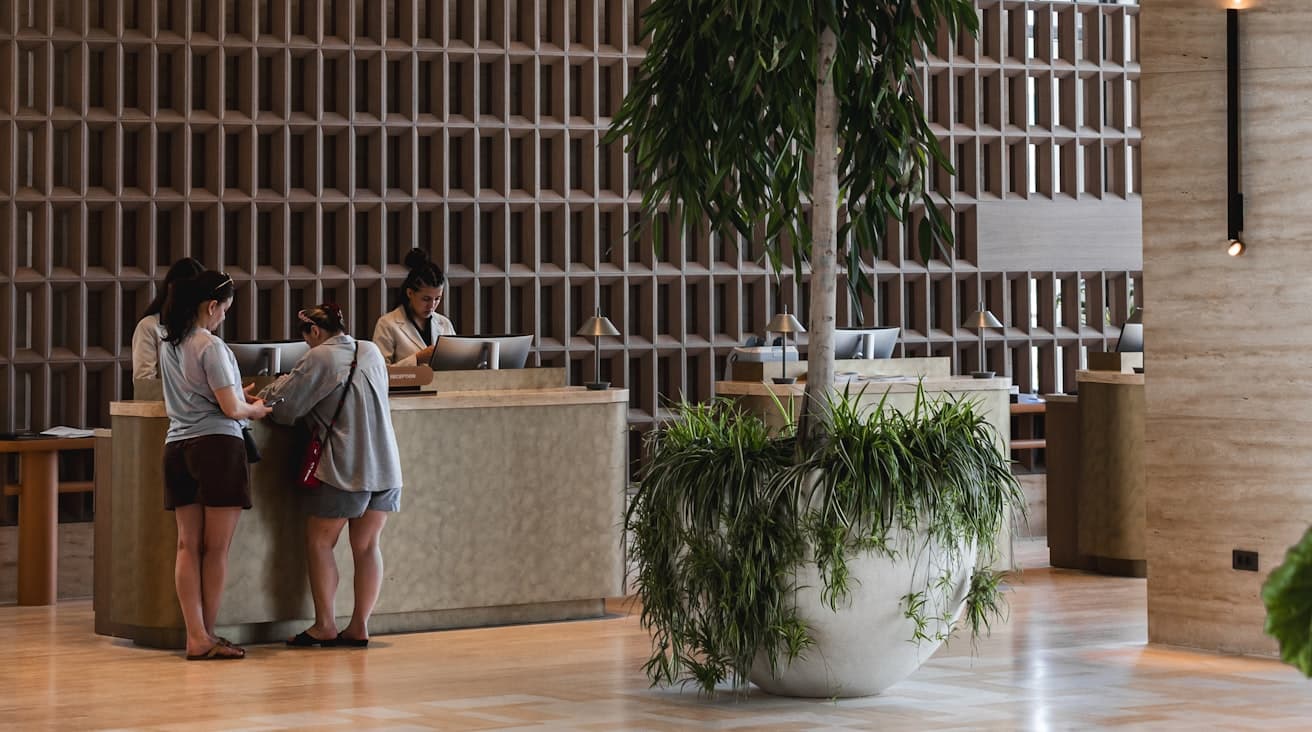
Check-in, the first SOP to write: it is where variability costs the most.
1. Checking in a guest who arrives early
It is the situation that produces the most improvisation at the front desk. The guest shows up at 12:30, the room is not ready, and the answer depends on who is on shift. An SOP fixes the order of questions to ask the floors, what to offer the guest while they wait, and the time after which you stop announcing a room.
Expected result, phrased verifiably: the guest knows one time — a single one — and that time was confirmed by the floor before being announced.
2. The turn-down after a check-out
The task is perfectly known to housekeepers, which makes people believe it does not need writing. It needs it the day the team is reinforced by a seasonal extra, at peak season, with no training time available.
A turn-down SOP fits in ten steps and three control points. It teaches an experienced housekeeper nothing; it makes an extra useful in twenty minutes.
3. The shift handover at the front desk
It is the most frequent breaking point in a hotel's information chain. Five minutes of conversation at the end of a shift systematically lose part of what matters: a promised commercial gesture, a late arrival, a room blocked from sale.
The handover SOP does not ask for more time — it imposes an order: what is in progress, what has been promised, what is broken. Three sections, written down, re-read by the person taking over.
SOP, checklist and handover note: three different objects
Confusing the three produces most of the useless documents. The SOP describes the method, once. The checklist verifies execution, every day. The handover note is one-off and dated: it concerns one guest, one room, one day, and it does not need to be kept.
A note that comes back three times is no longer a note — it is a procedure that has not been written yet. It is the best signal for choosing the next SOP.
The long workshop, with a document template validated upstream, produces nothing usable. The method that works is practised on site, with the person who runs the task.
Pick a task that has already gone wrong. The stakes are immediate and the discussion stays concrete.
Watch it done once, without intervening. Note everything that is written nowhere.
Write the steps with the person, not after them. They correct in real time what is wrong or useless.
Have it proofread by someone who never does this task. That reader finds the holes the expert no longer sees.
Set the control line before distributing. An SOP without control is not deployed — it is archived.
Writing in the conditional. “It would be advisable to check” cannot be controlled.
Naming people rather than roles. The document dies with the first departure.
Documenting the exception before the rule. Edge cases end up occupying three quarters of the text.
Distributing as a PDF by email. A procedure absent from the department's tool is not consulted during service.
Writing your SOPs with GROW.Group
GROW.Group writes the procedures with your teams, on the floor, starting from what is already done: an audit of existing operations, formalisation of the three costliest processes, then roll-out to the teams concerned.
The hub. for hotels app then carries these procedures where they serve. Handover notes and checklists are readable from the floor; room statuses and incidents reach the front desk without a phone call.
Who should write the SOPs in an independent hotel?
The person who runs the task, accompanied by the one who controls its result. Written by management alone, the procedure describes what management believes is done. Written by the operator alone, it reproduces their habits — including the bad ones.
How many SOPs does a 30-room hotel need?
Ten to fifteen cover most of the operation. Start with three, let them live for a quarter, then extend. A library of fifty procedures written in one go is never applied.
What is the difference between an SOP and an operating method?
None in practice. SOP is the term inherited from international chains; operating method is the industrial equivalent. Pick the word your teams understand, and stick to it in every document.
Should staff sign the SOPs?
The signature serves compliance, not operations. What gets a procedure applied is its presence in the tool used during service and a control line that is actually held — not a read receipt.
How often should an SOP be revised?
Whenever the floor changes: works, a new software, a change of season. In any case once a year, with the revision date on the document. A procedure without a date loses its credibility with the teams.
Does an SOP hurt service personalisation?
The standard concerns the method, not the relationship. A team that no longer spends its time catching up on oversights has the time and the information to genuinely personalise the welcome.
JV
Jason Vidalenc
Chief Experience & Commercial Officer, hub. for hotels
Spends more time in service corridors than in meeting rooms. Writes here about what circulates — or fails to — between the front desk and the floors.